

In this series of articles, we are exploring leak prevention systems in detail to give you all the information you need to make an informed decision in building & water management. Our previous article explored the technology involved and the insurance benefits.
In this series, we’re exploring leak prevention systems in detail to help you make informed decisions around building and water management. In our previous article, we looked at the underlying technology and the associated insurance benefits.
This article focuses on one of the most effective solutions available today: flow-based leak prevention systems.
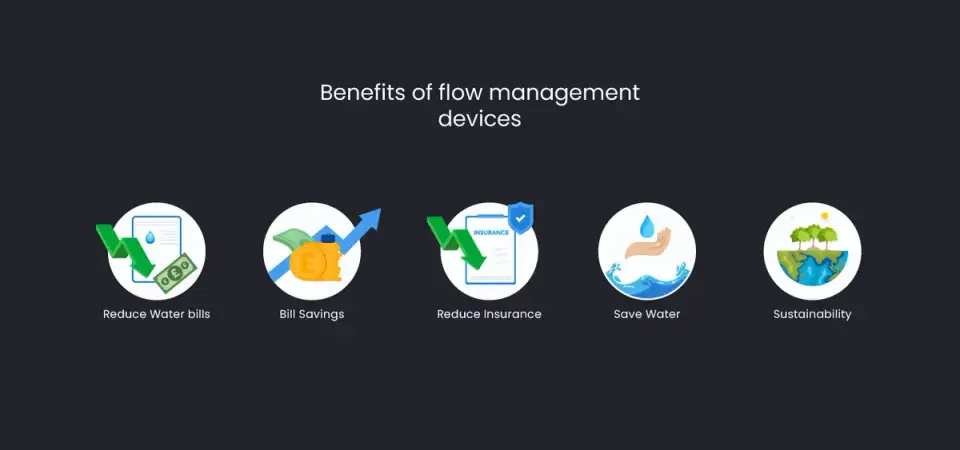
Flow Management Devices
A Flow Management Device consists of an automatic flow monitoring sensor (e.g high resolution water meter) connected to a smart shut-off valve. When integrated into a leak prevention system complete with smartphone app, it becomes a comprehensive solution to automatically detect and prevent leaks.
Installing a leak prevention system using flow management devices can provide numerous benefits to your building. Firstly, it can reduce your insurance deductibles and premiums, which can result in significant savings over time. Secondly, it can reduce water consumption, resulting in both environmental and financial benefits. Finally, it can help cut carbon emissions and contribute to a more sustainable future.
During construction, a leak prevention system will help prevent damage to your building. The automatic flow monitoring detects leaks in real-time, and the smart shut-off valve will automatically stop the water flow to prevent further damage. Different stakeholders can opt-in to receive alerts when leaks are detected, allowing them to investigate immediately or override the valve using the app.
Post-handover, a leak prevention system can provide multiple benefits for operational buildings. Again, leaks can be detected and prevented, reducing the risk of water damage, but there are other advantages too such as water bill savings and providing green credentials. Stakeholders, including concierge, insurers, owners, and tenants, can opt-in to receive leak alerts, providing them all with an opportunity to take proactive measures at different stages.
A decent leak prevention system will provide the following benefits during construction and post-handover (operational):
Construction site benefits
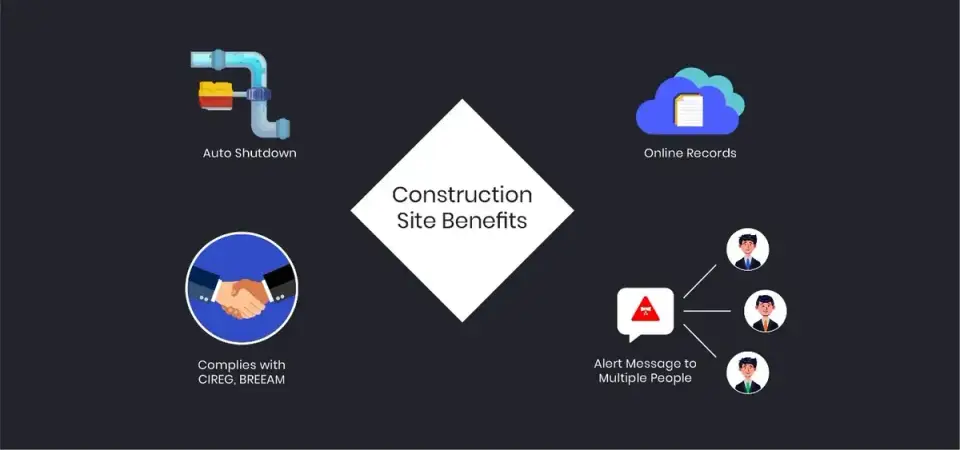
- Automatic water shut-off out-of-hours or when a leak (such as a burst pipe) is detected, reducing insurance claims from 63% to 11% on average.
- Prevent delays on site by having easy access to update site schedules and over-ride shut-off valve remotely from anywhere in the world.
- Multiple stakeholders can opt-in to get leak alerts meaning an alert doesn’t get missed.
- Full accountability and control of your site by having an online record of all alerts and valve operations associated with individual users.
- Complies with CIREG, BREEAM, and the Considerate Constructors Scheme (CCS) which highlights the importance of water saving and stresses the need for active monitoring and management of usage.
Operational benefits
- Automatic water shut-off water when a leak is detected, reducing insurance claims and deductibles.
- Multiple stakeholders can opt-in to get leak alerts e.g concierge, insurer, owner, and tenant.
- Online access, with selective permissions to limit who can shut the valve off and view data.
- Up to 60% cheaper bills by getting alerted to unnoticed leaks and wasted water going straight down the drain.
What to Look for in a Leak Prevention System
Not all systems offer the same level of performance. An effective solution should combine multiple sensors, intelligent software, and automated control.
Key features to consider include:
Comprehensive sensing
Flow monitoring and water contact sensors should be positioned at critical points to detect risk early and isolate problem areas.
Continuous monitoring and rapid response
The system should analyse water usage in real time and respond immediately to abnormal activity, including automatic shut-off where required.
Intelligent software
The platform should learn normal usage patterns, making it easier to detect anomalies. Scheduled shut-off options can also help manage water usage outside working hours.
Remote access and control
Users should be able to monitor activity, receive alerts, and control the system remotely via mobile or desktop.
Instant notifications
Alerts should be delivered in real time via app, SMS, or email to ensure issues are addressed without delay.
Backup power
To maintain protection during outages, systems should include backup power capable of supporting continued operation.
System compatibility
The solution should integrate with existing plumbing systems and, where required, connect to a Building Management System (BMS). Features such as sprinkler overrides are also essential for safety.
Ease of installation
The system should be straightforward to install with minimal disruption, while remaining fully operational throughout the construction phase.
What’s Next?
Once you have selected a supplier of leak detection technology you can proceed to the installation stage. This will be covered in our next article, coming very soon. In the meantime, if you want to discuss this further, reach out to our team at info@quensus.com for more information.